
Pale Blue Dot: A Vision of the Human Future in Space
Describes the first steps taken by humanity to explore space, and assesses the future before us as we step out into our system and beyond
Non-Fiction Science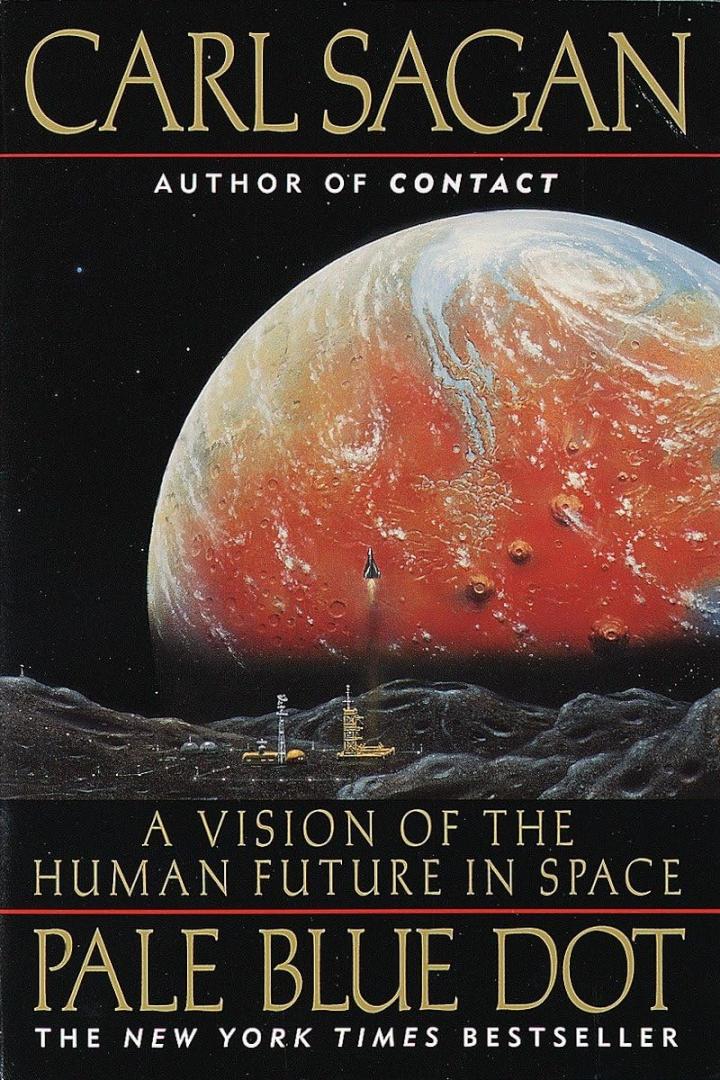
A sequel of sorts to his seminal “Cosmos”, Dr. Sagan titled this book on a lecture given by him with the same title. Just as the Voyager 1 was about to slingshot around Saturn and begin its journey away from the solar system, at the advice of Dr. Sagan, the probe was turned around and took a series of photographs of the solar system and all the planets visible. Entitled the “Family Portrait” series, this was taken at a distance of 6 billion kilometers from Earth.
At this distance, Earth does not even warrant one full pixel of image space. It just shows as a slightly pale blue discolouration. But, as Dr. Sagan put it in his lecture:
From this distant vantage point, the Earth might not seem of any particular interest. But for us, it’s different. Consider again that dot. That’s here. That’s home. That’s us. On it everyone you love, everyone you know, everyone you ever heard of, every human being who ever was, lived out their lives. The aggregate of our joy and suffering, thousands of confident religions, ideologies, and economic doctrines, every hunter and forager, every hero and coward, every creator and destroyer of civilization, every king and peasant, every young couple in love, every mother and father, hopeful child, inventor and explorer, every teacher of morals, every corrupt politician, every “superstar”, every “supreme leader”, every saint and sinner in the history of our species lived there – on a mote of dust suspended in a sunbeam.
Dr. Sagan charts out the Voyager missions, what the inspiration was, what they achieved and how their findings changed our understanding and perception of the cosmos. He went on to describe upcoming scientific missions, and what humanity might look like in the future, having ventured across the solar system and beyond. He also pragmatically observes that the petty squabbles of nations, and our blatant nearsightedness when it comes to planetary issues like climate change would sooner undo us than lead us to a grand multi-world civilization.
The book is loosely structured, meandering, filled with musings and tangents, written much like the lecture of a scientist whose thoughts are racing away and words are struggling to keep up. An excellent follow up to Cosmos.