William Blake
William Blake, the English poet, artist and mystic, was first apprenticed to an engraver and went on to study at the Royal Academy Schools. He reacted strongly against conformity and conventional realism in art, and was profoundly influenced by Michelangelo, as can be seen in his muscular figures and in the enormously dramatic concepts behind much of his work. The scenes he depicted were of his own invention, often illustrating his own poems, or linked to imaginative interpretations of Dante, Milton and the Bible.
Deeply if unconventionally religious, he was subject to visions; and his figures, although evidently muscular, are strangely insubstantial and unearthly, often surrounded by a supernatural light. Blake invented a highly personal and mysterious mythology, verbal and visual, to express his view of the world.
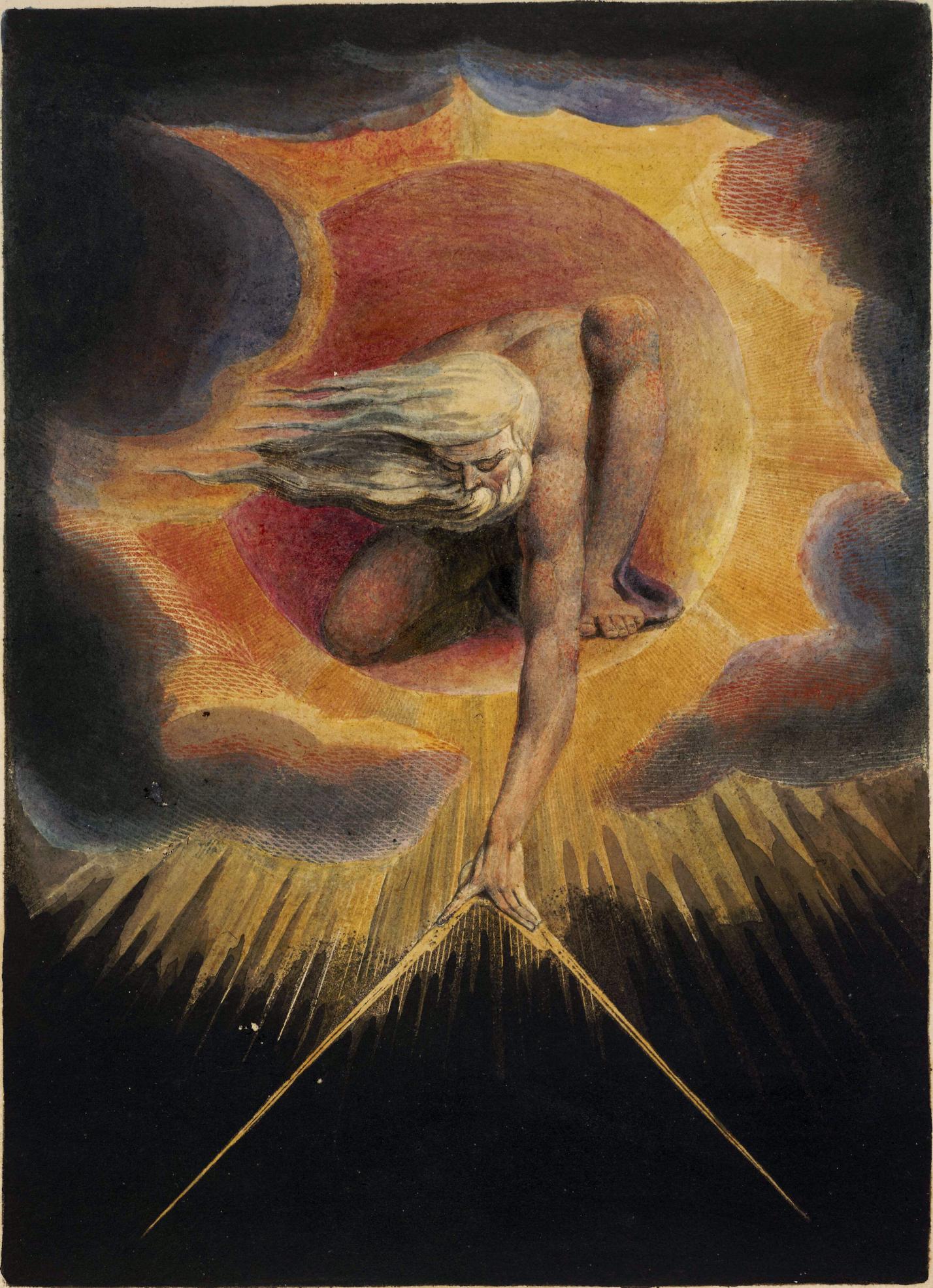 The Ancient of Days, or God Creating the Universe, is one of his best-known
images. It may have come to him complete in a vision; and it was an image to
which he frequently returned. It formed the frontispiece to one of his
prophetic books, Europe, from which this print is taken, and Blake was engaged
in hand-colouring a copy of it on his deathbed.
The Ancient of Days, or God Creating the Universe, is one of his best-known
images. It may have come to him complete in a vision; and it was an image to
which he frequently returned. It formed the frontispiece to one of his
prophetic books, Europe, from which this print is taken, and Blake was engaged
in hand-colouring a copy of it on his deathbed.
Urizen, the Creator, kneels in the orb of the sun, and reaches out into the void with a pair of golden compasses, with which to measure and plan the universe and its creatures. His long hair, and even longer beard, stream in the wind to his right, and rays of brilliant light burst through the clouds surrounding him. His powerful body is composed of finely balanced horizontal and vertical lines, framed by the disc of the sun, and linked to the diagonal lines of the compass. The left arm of the compass corresponds to a line taken through the kneeling figure from right knee to left and contributes to the wonderfully satisying harmony of the composition.
It is a work of tremendous elemental strength and energy, revealing something of the force that inspired Blake’s visionary mind.
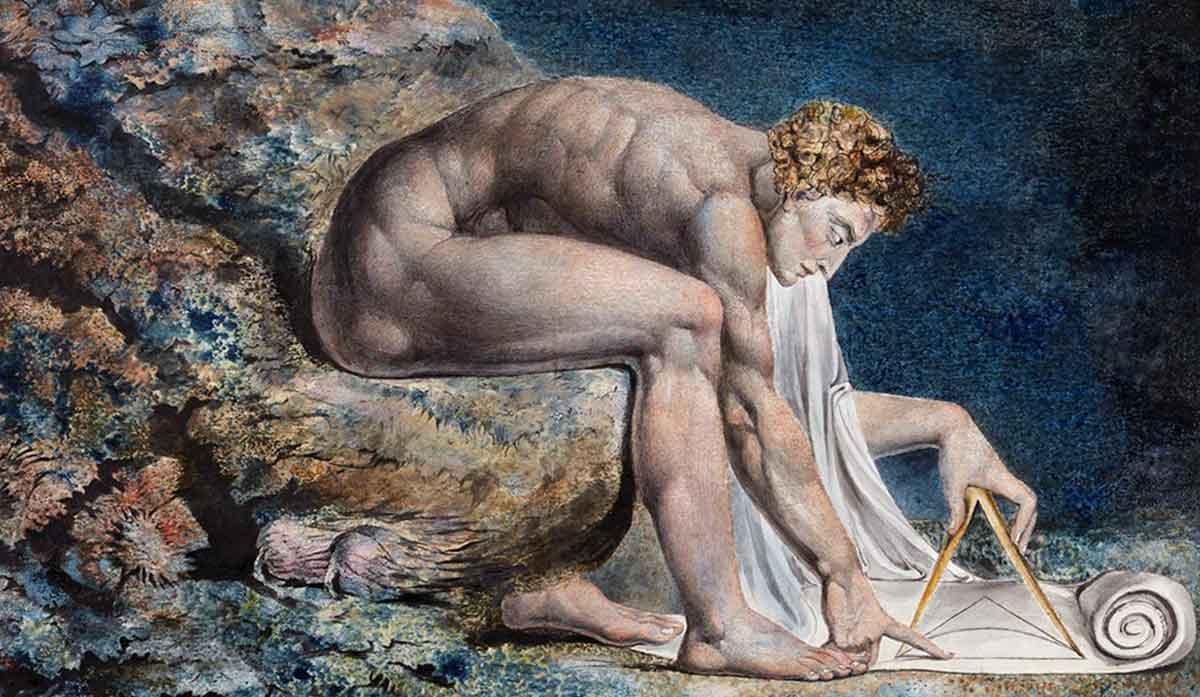 In this large, very accomplished colour print, Isaac Newton is shown busily
rationalizing the universe with the aid of a pair of compasses. Blake divided
the background with one bright and one dark section, implying that the great
mathematician and physicist brought not enlightenment but a godless night-time.
Blake believed that artists alone were capable of divine insight and that the
soul was always struggling to free itself from the confines of reason and
organized religion.
In this large, very accomplished colour print, Isaac Newton is shown busily
rationalizing the universe with the aid of a pair of compasses. Blake divided
the background with one bright and one dark section, implying that the great
mathematician and physicist brought not enlightenment but a godless night-time.
Blake believed that artists alone were capable of divine insight and that the
soul was always struggling to free itself from the confines of reason and
organized religion.
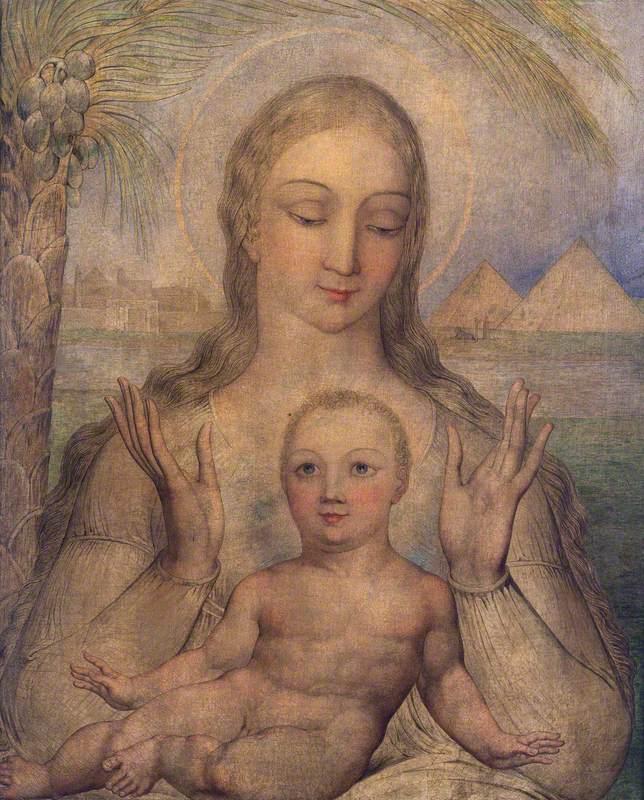 One of four similar paintings that Blake made in gratitude to his parton,
Thomas Butts, who supported him by sending his son for drawing lessons. Blake
thought it was more ethical to paint in tempera, a water based medium, than
oil, as it was more demanding of the artist’s skill.
One of four similar paintings that Blake made in gratitude to his parton,
Thomas Butts, who supported him by sending his son for drawing lessons. Blake
thought it was more ethical to paint in tempera, a water based medium, than
oil, as it was more demanding of the artist’s skill.
Gallery of Paintings